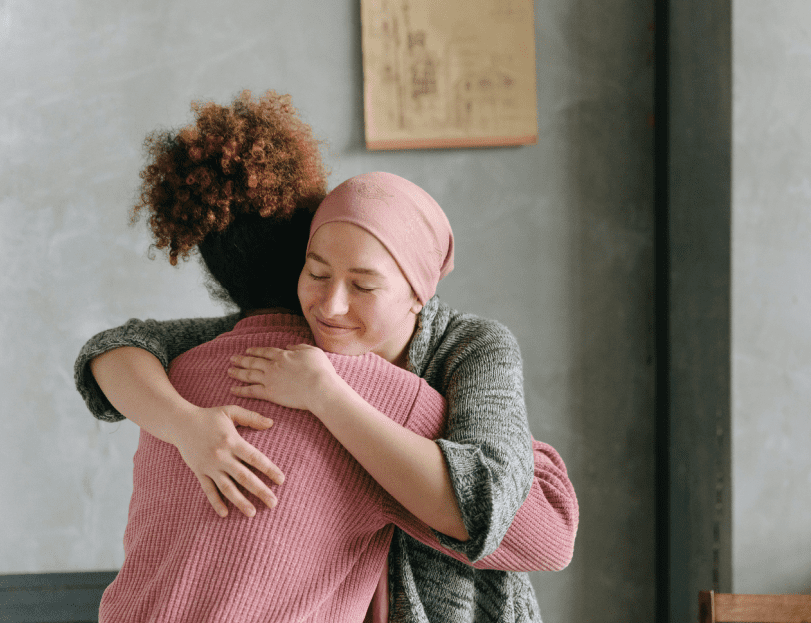
National Cancer Survivorship Day was celebrated yesterday, June 7. Always observed on the first Sunday of June, it is a day of reflection for many of the 18.6 million cancer survivors in the United States.
I was fortunate to celebrate the 10-year anniversary of completing chemotherapy last month. Rather than spending time reflecting on the devastation of a TNBC diagnosis, the pain of treatment, and the loss of the person I once was, I was instead given the gift of being matched with an Immerman Angels mentee.
Immerman Angels is an organization that provides peer-to-peer support for cancer patients. I signed up to be a mentor two years after treatment when I, like many other survivors, realized that one path to healing is helping others. By helping them, we help ourselves. My mentee was struggling with hair loss and fear of radiation. As a trained radiation therapist and someone who underwent 20 radiation treatments, I could definitely relate.
Hair loss was certainly something I could empathize with. I didn’t have a single hair on my entire body for several months. For me, it was freeing. It was one less thing demanding my energy, no more hair in the shower drain, and no more battling curls. But I know that isn’t the case for many women. I witnessed my fair share of chemotherapy chair meltdowns over hair loss and understand how devastating that loss of identity can be for some people.
Scalp cooling was beginning to gain momentum in 2016 when I was being treated, although it has been around since the 1970s. In the early days, it was fairly rudimentary, often involving ice packs or frozen vegetables placed on the head. That sounds dreadful to me! Even in 2016, patients often had to drag around a cooler full of ice and pay out of pocket for the equipment. I quickly ruled out that option.
Today, scalp cooling is entirely different and is widely utilized at many cancer centers with excellent results. I love this for the many women who report that losing their hair was traumatic and, in some cases, have even considered declining chemotherapy because of that fear.
Financial toxicity has also been a barrier to scalp cooling, but fortunately, that has been addressed at both the federal and state levels with meaningful progress. Scalp cooling originally fell under Category III CPT codes and was reimbursed in the hospital outpatient setting, but not in freestanding centers.
Starting January 1, 2026, the American Medical Association implemented new CPT codes for mechanical scalp cooling. These changes should open the door for Medicare reimbursement in both hospital and freestanding settings and may encourage broader coverage among commercial payors.
The new codes are:
- 97007 – Scalp cooling, mechanical; initial measurement and calibration of cap. Reported once per chemotherapy treatment period.
- 97008 – Mechanical scalp cooling, including hair preparation, individual cap placement, therapy initiation, and pre-cooling period. Reported once per chemotherapy session.
- 97009 – Mechanical scalp cooling provided after chemotherapy discontinuation, each additional 30 minutes. Reported in addition to 97008 for post-cooling of 16 minutes or longer.
Cancer survivorship is hard enough. I love these small wins that mean so much to so many patients. Celebrating innovations and advancements like these during Cancer Survivorship Month reminds us of the progress we’ve made, even in the little things, and the hope that lies ahead.
Happy Cancer Survivorship Month!